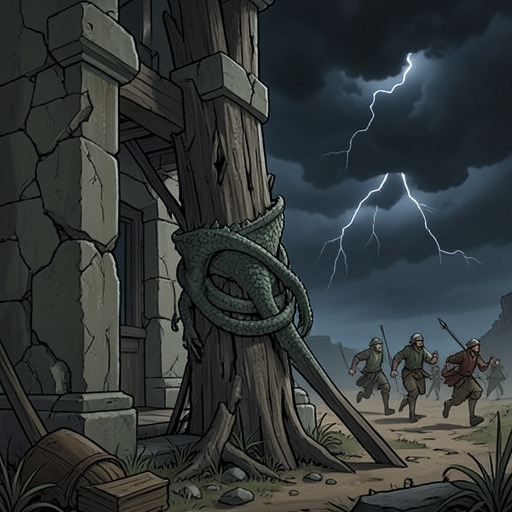
Tiresias
Metamorphoses (Ovid Edition)Tiresias is presented as a mortal whose unusual bodily history becomes the basis of divine authority. He is not introduced through ancestry, conquest, or a heroic quest, but through a dispute among Jupiter and Juno over the relative pleasure experienced by men and women. Because he has lived as both sexes, he can answer a question that the gods themselves cannot settle by argument alone.
Transformation and Double Experience
The decisive episode begins in a shaded wood, where Tiresias sees two snakes joined together. He strikes their intertwined bodies with his staff, and the blow changes him into a woman. The transformation is not described as a symbolic costume or a temporary disguise; it alters the sex through which he inhabits the world. After some interval, he encounters the snakes again and strikes them a second time. The reversal restores him to male form, so that his life contains direct experience of both sexual identities rather than knowledge gained from observation or hearsay.
This double transformation places Tiresias between stable categories. The snakes initiate the change, while the staff mediates it, making a simple gesture the instrument of a profound alteration. His condition therefore exemplifies the recurring logic of metamorphosis: an encounter produces bodily change, and a later repetition of the same action reverses it. Yet the experience leaves him with knowledge that cannot be erased when his original form returns.
Arbiter of the Gods
When Jupiter and Juno disagree, the gods appoint Tiresias as the sovereign umpire because he has tried the pleasure of each sex. His authority depends directly on embodied experience. Neither divine status nor abstract reasoning resolves the quarrel; the judgment is entrusted to the one figure who has occupied both positions under dispute.
Tiresias declares in favor of Jupiter. The verdict settles the question for Jupiter, but it enrages Juno. The episode thus makes knowledge politically dangerous: Tiresias is asked to speak because his experience is uniquely qualified, yet the truth he supplies violates the expectations of a powerful goddess. His impartial role as arbiter ends in divine retaliation, showing that even a correct judgment can become an offense when it exposes an unwelcome imbalance.
Speech, Power, and Punishment
The story places Tiresias within a larger pattern in which prayer, oath, command, and declaration carry supernatural force. Elsewhere, Themis is approached through solemn supplication, and a request made under the authority of the Styx binds the speaker to fulfillment. Tiresias’s own decisive act is different: his speech functions as testimony in a divine dispute, but its consequences reveal that speech is never merely descriptive in this world. Naming the truth changes the relations among the gods and provokes punishment.
The contrast between Tiresias and other metamorphic figures is especially sharp. Daphne’s transformation into a laurel follows pursuit and escape; Io’s transformation into a heifer is bound to concealment and divine power; Salmacis and Hermaphroditus become permanently joined through an irreversible fusion. Tiresias, by contrast, undergoes a reversible sequence from man to woman and back again. His metamorphosis does not simply remove him from human society or preserve him as a natural object. It returns him to the social world carrying an exceptional form of knowledge.
Narrative Role and Significance
Tiresias serves as a compact demonstration that transformation can produce authority as well as loss. His altered body is the condition of his credibility, and his credibility makes him useful to the gods; at the same time, the same bodily history exposes him to the anger of a deity whose pride the verdict wounds. The narrative treats experience as a form of evidence, but it also shows that evidence can threaten the powers that demand it.
His episode contributes to the work’s broader interest in unstable boundaries between human and divine, male and female, fixed identity and change. Tiresias is neither simply a victim of metamorphosis nor a triumphant master of it. He is a witness formed by change, summoned to judge because he has crossed a boundary others have not, and endangered because he speaks from that crossing with unwelcome precision.